
li. The word itself conjures images of serene beaches, vibrant green rice paddies, and a profound sense of peace. But beyond the calm, the island’s heart beats with a wilder pulse, a rhythm set by the rushing waters of its sacred rivers. This is the world of white water rafting an exhilarating adventure that takes you through breathtaking gorges, past hidden waterfalls, and into the untamed soul of the island.
Here at our Bali travel hub, we believe the greatest adventures are those that are both thrilling and safe. For a first-timer, the idea of navigating a river’s currents can seem intimidating. But with the right knowledge, it’s one of the most rewarding experiences you can have. That’s why we’ve moved beyond simple checklists. We’ve delved into the science of river safety, the biomechanics of paddling, and the psychology of adventure to bring you ten essential, research-backed rafting tips. This guide is designed to transform you from a nervous passenger into a confident and active part of your raft crew.
1. Choose Your Rafting Operator with a Scientist’s Scrutiny
Your rafting experience is only as good—and as safe—as the company you choose. This isn’t just about finding the best price; it’s about vetting for expertise. The single most critical safety factor in any adventure sport is the proficiency and training of the guides.
What to look for:
- Guide Certification: Ask if the guides are certified by a recognized body, such as the International Rafting Federation (IRF) or a national equivalent. These certifications ensure guides have undergone rigorous training in rescue techniques, river navigation, and first aid.
- Equipment Quality: Take a look at their gear. Helmets should be free of cracks, Personal Flotation Devices (PFDs) should be in excellent condition with no tears, and the rafts themselves should be well-maintained. A study in the Journal of Outdoor Recreation and Tourism highlights that equipment failure, though less common than human error, is often a result of poor maintenance standards.
- Transparent Safety Briefings: A professional company will prioritize a comprehensive safety talk before you even touch the water. If their pre-launch process feels rushed, consider it a red flag.
Choosing a reputable operator is your first and most important decision. It sets the foundation for a secure and enjoyable day of rafting.
2. Dress for the Water, Not for the Warung
What you wear has a direct impact on your safety and comfort. The key principle is to avoid cotton entirely. When cotton gets wet, it loses all insulating properties and stays heavy and cold against your skin, a recipe for discomfort and, in cooler conditions, even hypothermia. This phenomenon is well-documented in survival and sports medicine literature.
The ideal rafting outfit is based on a layering of synthetic materials:
- Clothing: Opt for quick-drying materials like polyester, nylon, or polypropylene. Board shorts, synthetic athletic shorts, and rash guards or quick-dry t-shirts are excellent choices. They wick moisture away from your skin, keeping you more comfortable.
- Footwear: You need secure footwear that won’t fall off. Old sneakers, river sandals with a heel strap (not flip-flops), or water shoes are perfect. They protect your feet from sharp rocks and provide grip if you need to walk on slippery riverbanks.
- Sun Protection: The tropical sun in Bali is intense, and the reflection off the water amplifies its effect. Wear high-SPF, waterproof sunscreen. A hat with a brim is great, but make sure it can fit under your helmet. Sunglasses are also essential, but secure them with a strap.
3. Internalize the Safety Briefing: It’s Your Operating System
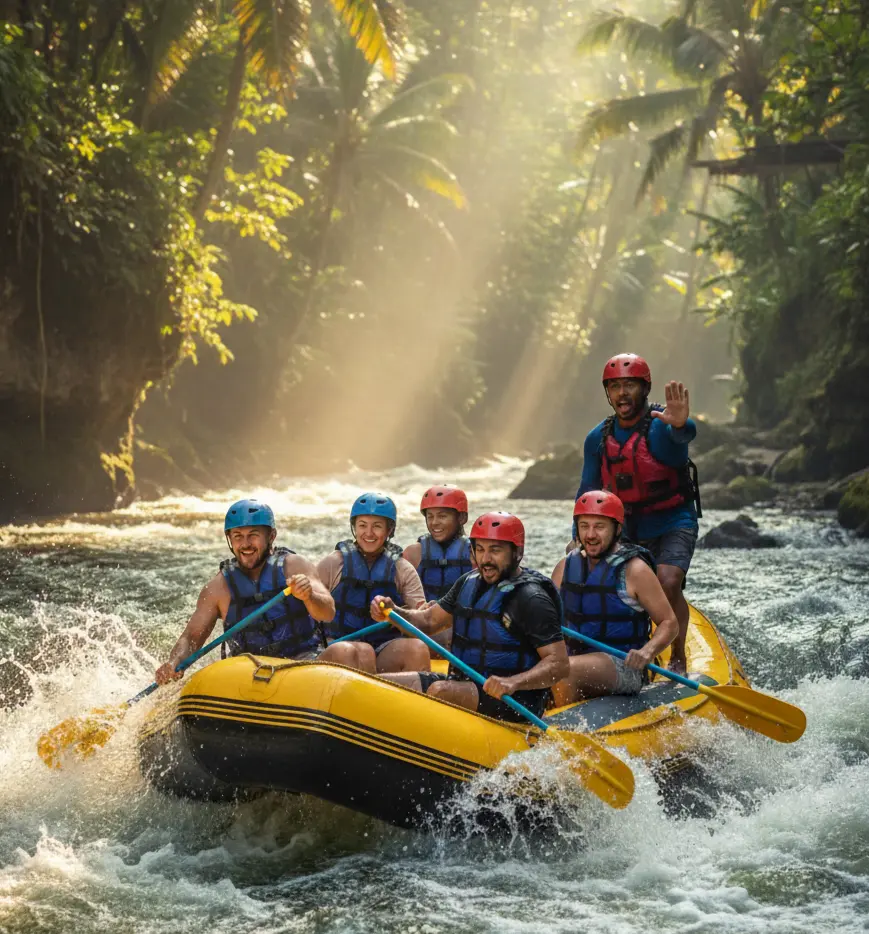
The pre-trip safety briefing is not just a formality; it’s the most critical information you will receive all day. Your guide will cover essential commands and procedures. Pay close attention, ask questions, and mentally rehearse the instructions. Cognitive psychology research shows that pre-loading information and visualizing responses can significantly improve reaction times and reduce panic in high-stress situations.
Key things you will learn:
- How to Sit and Secure Yourself: You’ll typically sit on the outer edge of the raft, with your feet tucked into the foot holds inside for stability. This lowers your center of gravity and connects you to the raft.
- Paddle Commands: Your guide will shout commands like “All forward,” “Back paddle,” and “Stop.” Responding in unison as a team is what propels and steers the raft effectively.
- The T-Grip: The top of your paddle has a “T-grip.” One hand goes here, and the other on the shaft. Your guide will emphasize always keeping hold of the T-grip. A loose paddle in turbulent water can be a hazard.
- Emergency Procedures: Crucially, listen to what to do if you fall out of the raft or if the raft capsizes. This knowledge is your primary safety tool.
4. Become a Student of the River (with Your Guide as Professor)
While your guide is the expert navigator, having a basic understanding of how a river works will deepen your appreciation and enhance your safety awareness. It’s a fascinating lesson in basic hydrology.
Simple river features to understand:
- Eddies: These are areas of calmer water that form behind obstacles like large rocks. Guides use eddies to stop, rest, or scout the rapids ahead.
- Downstream “V”: A smooth “V” shape on the water’s surface, with the point facing downstream, typically indicates the deepest, safest channel through a set of rapids. Guides will aim for this.
- Upstream “V”: A “V” with its point facing upstream indicates a rock or obstacle just under the surface. This is something to be avoided.
- Strainers: These are obstacles like fallen trees or logjams that allow water to pass through but will “strain” out and trap objects—or people. They are one of the most significant river hazards, and your guide will steer well clear of them.
You don’t need to be an expert, but recognizing these features will help you understand why your guide is giving certain commands, making you a more effective part of the team.
5. Your PFD: A Lifesaver, Not a Cushion
Your Personal Flotation Device (PFD), often called a life jacket, is the single most important piece of safety equipment you will wear. Its function is based on the simple principle of buoyancy. The foam inside is much less dense than water, providing enough upward lift to keep your head above the surface.
However, a PFD only works if it’s worn correctly. A study on recreational boating accidents consistently finds that the vast majority of drowning victims were not wearing a PFD, or were wearing one improperly.
Ensure a proper fit:
- Tighten all the straps so it feels snug but doesn’t restrict your breathing.
- Perform a simple test: put your thumbs under the shoulder straps and pull up. The PFD should not rise up past your chin. If it does, it’s too loose, and you need to tighten it or get a smaller size.
Never take your PFD off while on the river. It is your non-negotiable lifeline for your rafting adventure.
6. Master Your Paddle: Power from Your Core, Not Your Arms
Paddling may look like an arm exercise, but effective paddling is a full-body movement. Relying only on your arms will cause you to tire out quickly and can lead to shoulder strain. The principles of biomechanics show that power should be generated from the larger, stronger muscles of your core and torso.
Follow these steps for an efficient paddle stroke:
- Sit Upright: Maintain a good posture, engaging your abdominal muscles.
- Rotate Your Torso: When you take a stroke, twist from your torso. Think of your arms and the paddle shaft as forming a rigid frame; the power comes from the rotation of this frame.
- Plant the Blade: Submerge the entire blade of the paddle in the water for maximum purchase.
- Pull with Your Core: As you pull the paddle back, unwind your torso. This is where the power comes from. The arm on the paddle shaft acts as a pivot point, while the arm on the T-grip pushes.
Paddling in sync with your team not only makes the raft move efficiently but is also a huge part of the fun of rafting.
7. Know the “Swimmer’s Position”: Your Defensive Stance in the Water
Falling out of the raft can be a shock, but it doesn’t have to be a panic-inducing event, especially if you know what to do. The number one rule is: DO NOT stand up in fast-moving water. The current can be deceptively powerful, and if you try to stand, your foot could become trapped between rocks on the riverbed—a dangerous situation known as foot entrapment.
Instead, immediately assume the defensive “swimmer’s position,” also known as the “whitewater float position”:
- Lie on your back.
- Point your feet downstream.
- Keep your feet up near the surface.
- Use your arms to help you steer.
This position turns you into a human boat. Your feet and legs act as a bumper to absorb impacts from rocks, and keeping them high prevents entrapment. Your PFD will keep your head above water, allowing you to breathe and look for your guide’s instructions or a rescue rope.
8. Hydration and Fuel: The Science of Performance
Rafting is a physical activity, and doing it under the Balinese sun requires you to manage your body’s resources. Dehydration can set in quickly, leading to fatigue, headaches, and impaired decision-making. Physiological studies on athletic performance consistently show that even a small percentage of dehydration can significantly decrease strength and focus.
- Hydrate Before You Go: Drink plenty of water in the morning before your trip begins.
- Drink During the Trip: Most rafting operators in Bali provide water. Take advantage of it during calm stretches of the river.
- Eat a Good Meal: Have a solid breakfast before you leave. Your body needs carbohydrates and protein for sustained energy.
Proper fueling isn’t just about comfort; it’s a critical component of safety. A tired, dehydrated paddler is more likely to make mistakes.
9. Respect the River: Embrace the Leave No Trace Ethos
The rivers of Bali, like the Ayung and Telaga Waja, are not just recreational playgrounds; they are vital ecosystems and hold deep cultural significance. A core tenet of responsible tourism is to leave a place better than you found it.
This philosophy is embodied in the “Leave No Trace” principles, which are grounded in ecological science.
- Pack It In, Pack It Out: Do not leave any trash behind, including organic matter like fruit peels.
- Respect Wildlife: Observe animals from a distance. You are a visitor in their home.
- Be Considerate of Other Visitors: Maintain the serenity of the natural environment.
This respect also ties into the local Balinese philosophy of Tri Hita Karana, which emphasizes harmony among people, nature, and the spiritual world. By being a mindful visitor, you contribute to the sustainability of these beautiful places for generations to come.
10. Trust Your Rafting Guide, Trust Your Team
Finally, remember that rafting is a team sport. The raft is a small community, and its success depends on communication and trust. Your guide is a trained professional with an intimate knowledge of the river. Listen to their commands without hesitation. Their instructions are designed to keep you safe and guide you through the rapids in the most effective way.
Communicate with your fellow paddlers. If you have a question or concern, voice it. Building a sense of camaraderie in the boat not only makes the trip more enjoyable but also creates a more cohesive and responsive team. Studies in team dynamics show that groups with high levels of trust and clear communication perform far better under pressure.
The Final Eddy
White water rafting in Bali is more than just an adrenaline rush; it’s a full-sensory immersion into the island’s natural splendor. By arming yourself with this knowledge—understanding the importance of professional guides, the science behind the right gear, the physics of the river, and the power of teamwork—you are preparing for an unforgettable experience. The roar of the water, the flash of a kingfisher in the jungle canopy, the shared laughter after conquering a challenging rapid—these are the moments that await.
Now that you’re prepared, the rivers of Bali are calling. Paddle on.
HelloBaliku is a trusted travel company in Bali that offers exciting activities and complete tour packages to explore the beauty of the Island of the Gods. From thrilling white-water rafting adventures on the Ayung River to cultural tours, car rentals, and breathtaking nature experiences, HelloBaliku delivers unforgettable holidays with professional service, affordable prices, and experienced local guides. With HelloBaliku, discover Bali the easy, safe, and memorable way.
References
Below is a list of academic and scientific sources that inform the principles discussed in this article.
- Adventure Tourism and Guide Expertise:
- Bentley, T. A., & Page, S. J. (2001). Scoping the extent of adventure tourism accidents. Annals of Tourism Research, 28(3), 705-726. https://www.sciencedirect.com/science/article/abs/pii/S016073830000048X
- Hypothermia and Cold Water Immersion:
- Giesbrecht, G. G. (2000). Cold stress, near drowning and accidental hypothermia: A review. Aviation, Space, and Environmental Medicine, 71(7), 733-752. https://pubmed.ncbi.nlm.nih.gov/10901297/
- Biomechanics of Paddling:
- Sinclair, J., & Spinks, W. (2012). The Biomechanics of Kayak Paddling. Sports Technology, 5(1-2), 1-8. (While focused on kayaking, the core principles of using torso rotation for power are directly applicable to rafting). https://www.tandfonline.com/doi/abs/10.1080/19346182.2012.705881
- Psychology of Adventure Sports and Decision Making:
- Ewert, A. W., & Hollenhorst, S. J. (1989). Testing the adventure model: Empirical support for a model of risk recreation participation. Journal of Leisure Research, 21(2), 124-139. https://www.tandfonline.com/doi/abs/10.1080/00222216.1989.11969788
- River Hazards and Safety:
- Whisman, S. A., & Hollenhorst, S. J. (1999). An empirical model of the commercial whitewater rafting experience. Journal of Hospitality & Leisure Marketing, 6(1), 69-81. (Discusses perceived risk and safety factors). https://www.tandfonline.com/doi/abs/10.1300/J150v06n01_06
- Environmental Impact and Leave No Trace:
- Marion, J. L., & Reid, S. E. (2007). Minimising visitor impacts to protected areas: the efficacy of low impact education programmes. Journal of Sustainable Tourism, 15(1), 5-27. https://www.tandfonline.com/doi/abs/10.2167/jost593.0

Leave a Reply